Everyone is talking about AI in healthcare. The presentations. The white papers. The conference keynotes. The breathless announcements about large language models that will revolutionize diagnosis, predict readmissions, eliminate administrative burden, and usher in a new era of precision medicine.
It is exciting. It is also incomplete.
Because nobody is asking the question that actually determines whether any of it works.
Where is the AI getting its data?
A model is only as intelligent as the information it learns from.
Feed an AI clean, structured, standardized, longitudinal clinical data and it can do extraordinary things — identify patterns across millions of patient encounters, flag drug interactions a human might miss, predict deterioration before symptoms appear, surface the right intervention at the right moment.
Feed it fragmented, inconsistent, unstructured, siloed data pulled from a dozen incompatible legacy systems — and it will do extraordinary things with that too.
It will be extraordinarily wrong. Confidently. At scale.
Garbage in, garbage out has always been true. AI does not change that rule. It amplifies it.
This is the inconvenient truth about healthcare AI.
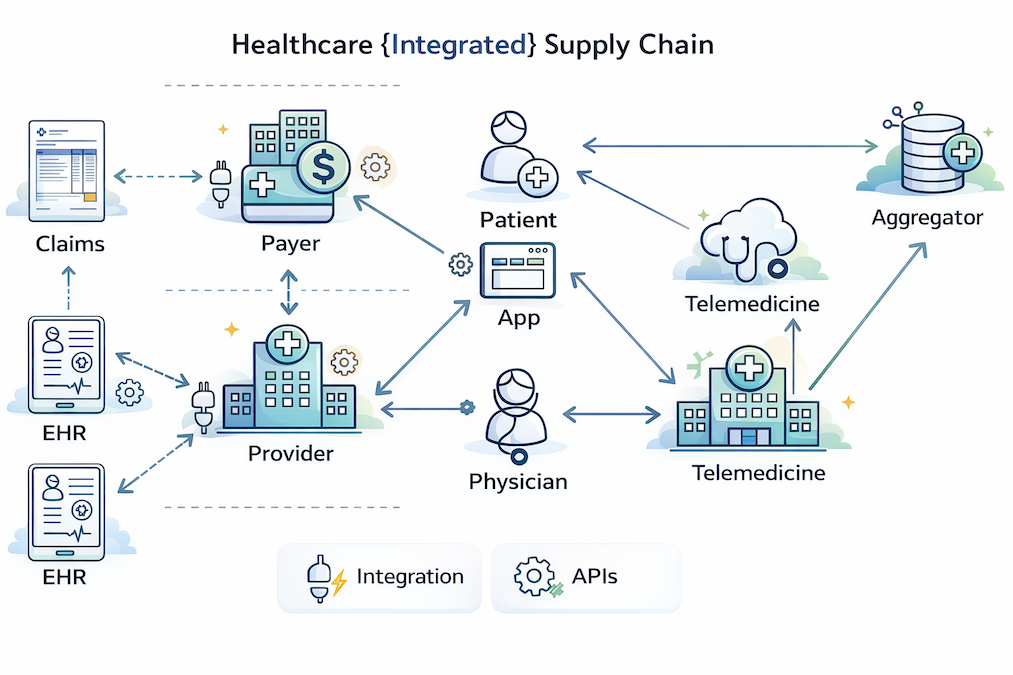
Most clinical data today is not AI-ready. It is buried in free-text notes. It is locked in proprietary EHR formats that do not speak to each other. It is inconsistently coded, incompletely documented, and scattered across systems that were never designed to share.
You cannot build reliable clinical intelligence on top of that foundation. You can build something that looks impressive in a demo. You can build something that performs well on a curated dataset in a research environment. But in the real world, with real patients, across real care settings — the data problem swallows the AI promise whole.
The most sophisticated model in the world cannot compensate for a medication list that hasn’t been reconciled in two years. It cannot reason across a care journey it can only see fragments of. It cannot learn from outcomes data it was never given access to.
AI without clean data is not artificial intelligence. It is artificial confidence.
This is why FHIR is more important than AI.
Not because AI is not powerful. It is. Not because the future of clinical decision support is not algorithmic. It probably is.
But because FHIR is the foundation that makes any of it real.
FHIR — Fast Healthcare Interoperability Resources — is the federal standard for structured health data exchange. When healthcare systems operate on FHIR-native infrastructure, something fundamental changes. Clinical data stops being a byproduct of documentation and becomes a structured, standardized, interoperable asset. Every diagnosis, every medication, every lab result, every functional outcome is captured in a consistent format that any connected system — including an AI — can actually read, process, and learn from.
FHIR does not just move data. It makes data trustworthy.
And trustworthy data is the only kind an AI should ever be making clinical recommendations from.
Think about it this way.
AI is the engine. FHIR is the fuel. And right now, healthcare is standing in a field full of crude oil — enormous quantities of raw clinical data with immense latent value — while the industry holds conferences about how fast the engine can go.
The engine does not matter until the fuel is clean.
Get the data infrastructure right first. Build on FHIR-native, interoperable, standardized clinical data. Then unleash the AI — and watch what becomes possible when it actually has something trustworthy to learn from.
At Zenro Link, we believe the same thing.
Before the algorithm. Before the model. Before the prediction engine. There has to be a clean, structured, interoperable data foundation.
That is what we build. That is what FHIR makes possible. And that is why the organizations investing in FHIR infrastructure today are not just preparing for regulatory compliance.
They are building the foundation that every meaningful AI application in healthcare will eventually depend on.
Fix the data first. The intelligence will follow.
🔗 ZenroLink.com
Zenro Link — Care Without Barriers
#ZenroLink #FHIR #HealthcareAI #HealthIT #AIinHealthcare #DigitalHealth #CareWithoutBarriers #HealthTech #DataInteroperability #ClinicalAI #HealthcareInnovation #FHIRNative #CleanData